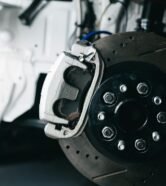
If you drive a BMW, Mercedes-Benz, Audi or Porsche, you’ve probably noticed two things: your wheels get covered in black dust, and your brake jobs come around sooner than they did on your last car. That’s not a defect. It’s how European performance brakes are designed, and understanding why helps you avoid paying for the same brake job twice.
European Brakes Are Built to Stop Hard, Not Last Forever
German and Italian manufacturers tune their brakes for high-speed stopping. Cars sold in Europe are expected to come down from autobahn speeds repeatedly without fading, and that same hardware ends up on the cars we drive in Las Vegas.
To get that performance, European brake systems make a few trade-offs:
- Softer, high-friction pads. Most factory pads use a low-metallic compound that grips aggressively. It stops well, but it wears faster and throws off the dark dust you see on your wheels.
- Rotors treated as wear parts. Many European rotors are thinner and lighter than domestic equivalents and are designed to wear along with the pads. On most BMWs and Mercedes, rotors are replaced with every pad change rather than resurfaced.
- Bigger cars, bigger loads. A Mercedes GLE, BMW X5 or Porsche Cayenne weighs well over two tons. Heavy SUVs with performance tires put a lot of energy into the brakes on every stop.
The result: it’s common for European cars to need pads and rotors somewhere in the 25,000 to 40,000 mile range, sometimes sooner on performance models or with heavy city driving.
Why Las Vegas Is Harder on Brakes
Valley driving adds its own stress. Stop-and-go traffic on the Strip, Flamingo and Tropicana means constant heat cycling. Summer pavement temperatures push brake fluid and pads hotter before you even touch the pedal. And trips to Mount Charleston or Red Rock involve long downhill grades that build heat fast.
Heat is also hard on brake fluid. Brake fluid absorbs moisture over time, which lowers its boiling point. Most European manufacturers call for a brake fluid flush every two years regardless of mileage, and that interval matters even more here.
Warning Signs Your European Car Needs Brake Service
European cars usually tell you before the brakes get critical, but not always. Watch for:
- Brake wear warning light or message. BMW, Mercedes, Audi and Porsche use electronic wear sensors. When the light comes on, you typically have a limited amount of pad left — don’t wait months.
- Squealing or grinding. Grinding usually means metal-on-metal contact and damage to the rotors.
- Vibration or pulsing in the pedal or steering wheel during braking, often from uneven rotor wear or pad deposits.
- Longer stopping distances or a soft pedal, which can point to worn pads, old fluid or a hydraulic problem.
- The car pulling to one side when you brake, often from a sticking caliper.
Carbon-Ceramic Brakes on Porsche, Ferrari, Lamborghini and McLaren
Many high-performance and exotic models use carbon-ceramic rotors, such as Porsche’s PCCB or the systems on Ferrari, Lamborghini and McLaren models. These rotors are extremely heat resistant and, with normal street driving, can last far longer than iron rotors. But replacements are very expensive, so correct pads, correct bedding and careful inspection matter. A shop that treats them like ordinary rotors can shorten their life considerably.
What a Proper European Brake Job Includes
A cheap brake job usually means slapping pads on old rotors and calling it done. On a European car, a complete service should include:
- Inspecting pads, rotors, calipers, hoses and brake fluid condition
- Replacing pads and rotors as a set, with OEM-quality parts matched to your model
- Installing new electronic wear sensors (they’re designed for one use)
- Cleaning and lubricating caliper slide points
- Torquing everything to factory specification
- Resetting the brake service interval and, where equipped, servicing the electronic parking brake with a scan tool
- Test driving to confirm smooth, quiet, even braking
Skipping the sensor, the electronic parking brake procedure or the service reset can leave you with warning lights, noise or uneven wear down the road.
Frequently Asked Questions
Why is there so much brake dust on my BMW or Mercedes wheels?
Factory pads on most European cars use a high-friction compound that sheds more material as it wears. Lower-dust ceramic pads are available, but they can change pedal feel and stopping performance, so it’s worth discussing the trade-off before switching.
Do I have to replace rotors every time I replace pads?
On most European cars, yes. The rotors are designed to wear with the pads, and they’re often below minimum thickness by the time the pads are done. Putting new pads on worn rotors usually leads to noise, vibration and a shorter pad life.
How often should I flush brake fluid on a European car?
Most manufacturers recommend every two years. In Las Vegas heat, sticking to that interval is important because old, moisture-contaminated fluid boils at lower temperatures.
Can any shop work on carbon-ceramic brakes?
Any shop can, but not every shop should. Carbon-ceramic rotors require specific pads, careful handling and proper inspection to avoid expensive damage. Choose a shop with experience on high-performance and exotic vehicles.
Get Your Brakes Checked in Las Vegas
If your brake warning light is on or something doesn’t feel right, don’t wait for it to turn into a rotor or caliper replacement. Eurohaus Motorsports performs European and exotic brake repair in Las Vegas with OEM-quality parts and dealer-level equipment. We’ll also check your suspension and steering components while the wheels are off. Call (725) 204-5884 or request an appointment online.